(http://homepages.stmartin.edu/Fac_Staff/rlangill/HIS%20217%20maps/Qin%20dynasty%20map.JPG).
Reason for Take-Over: The main reason for the take-over of the Qin Dynasty was the strength of there army, but first it was the fall of the Zhou Dynasty that led to the Qin Dynasty. The Zhou Dynasty’s most powerful emperor died and caused the royal line to break. The nobles lost hope in their fast changing emperors and declared themselves as the king. (http://en.wikipedia.org/wiki/Zhou_Dynasty#Decline).
During the downfall of the Zhou Dynasty, the Warring States Period was going on, in which the Qin proved to be the strongest Dynasty, conquering every other warring state. It was later in 223 BC that Qin Shi Huangdi, king of Qin, unified

(http://sacu.org/WarringStates.png)
Leaders of this Civilization: Qin Shi Huangdi was the first emperor that decided to run his state as an aristocratic system. He was the most well known leader out of the three other emperors, but not as popular amongst his people. (http://www.mnsu.edu/emuseum/prehistory/china/early_imperial_china/qin.html). Qin Shi Huangdi ruled from 221 BC to 210 BC. The second emperor was Huhai, Qin Shi’s youngest son. He ruled till the October of 207 BC. The third emperor was Ziying, son of Fusu (Qin Shi’s first son), after Huhai was forced to commit suicide. (http://en.wikipedia.org/wiki/Qin_Dynasty).

This is Emperor Qin Shi Hunagdi.
(http://www.arqueologos.org/IMG/jpg/Qin_Shi_Huangdi.jpg)
Another Civilization: During the reign of the Qin Dynasty, another civilization was ruling outside China. King Philip V took over the throne in 221 BC, at the age of 17. He ruled from 221 BC to 179 BC. His first war was The Social War, fought between 220 BC and 217 BC. King Philip V fought his second war between 217 BC to 206 BC. This war was called the First Macedonian War. Although, King Philip ruled for a lot longer, at 206 BC the Qin Dynasty fell apart.
(http://en.wiki.org/wiki/Philip_V_of_Macedon)

King Philip V
(http://www.ambientece.arti.beniculturali.it/guida_reggia/immagini/1120a.jpg)
Accomplishments: There were huge amounts of successes, which brought great wealth and increased the economy of

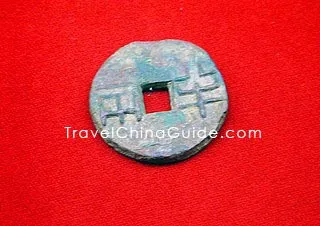
These are the copper coins used for trade.
(http://www.travelchinaguide.com/images/photogallery/volunteer/currency%201v000655tm.jpg)

This is the Great Wall of China.
(http://www.chinareview.com/images/attractions-great-wall.jpg)

This is the Terracotta Army, located in the Emperor Qin's tomb.
(http://www.wayfaring.info/images/Qin_Terra_Cotta_Warriors.jpg)
Reason for Fall: Emperor Qin Shi Huangdi proved to be the best emperor during the Qin Dynasty because the other two emperors lasted only four years. Although, Emperor Qin was good, he did a huge mistake by burning books, which angered the peasants. Emperor Qin died due to mercury poisoning and soon after the whole of
Bibliography:
2.(http://www.mnsu.edu/emuseum/prehistory/china/early_imperial_china/qin.html).
3. (http://en.wikipedia.org/wiki/Zhou_Dynasty#Decline).
4. (http://en.wikipedia.org/wiki/Warring_States_Period).
5. (http://en.wikipedia.org/wiki/Legalism_%28philosophy%29).
6. (http://library.thinkquest.org/12255/library/dynasty/qin.html).