Saturday, January 12, 2008

Qin Dynasty


Dates of Power: The Qin Dynasty rose to power after the Zhou Dynasty. The Qin Dynasty lasted between 221 BC and 206 BC. The area occupied covered the whole of north-eastern China and almost the whole of south-eastern China. (http://en.wikipedia.org/wiki/Qin_Dynasty).


Reason for Take-Over: The main reason for the take-over of the Qin Dynasty was the strength of there army, but first it was the fall of the Zhou Dynasty that led to the Qin Dynasty. The Zhou Dynasty’s most powerful emperor died and caused the royal line to break. The nobles lost hope in their fast changing emperors and declared themselves as the king. (http://en.wikipedia.org/wiki/Zhou_Dynasty#Decline). 

During the downfall of the Zhou Dynasty, the Warring States Period was going on, in which the Qin proved to be the strongest Dynasty, conquering every other warring state. It was later in 223 BC that Qin Shi Huangdi, king of Qin, unified China and became the next Emperor of China. (http://en.wikipedia.org/wiki/Warring_States_Period).

These are the warring states that fought each other during the Warring States Period.

(http://sacu.org/WarringStates.png)


Leaders of this Civilization: Qin Shi Huangdi was the first emperor that decided to run his state as an aristocratic system. He was the most well known leader out of the three other emperors, but not as popular amongst his people. (http://www.mnsu.edu/emuseum/prehistory/china/early_imperial_china/qin.html). Qin Shi Huangdi ruled from 221 BC to 210 BC. The second emperor was Huhai, Qin Shi’s youngest son. He ruled till the October of 207 BC. The third emperor was Ziying, son of Fusu (Qin Shi’s first son), after Huhai was forced to commit suicide. (http://en.wikipedia.org/wiki/Qin_Dynasty).


This is Emperor Qin Shi Hunagdi.
(http://www.arqueologos.org/IMG/jpg/Qin_Shi_Huangdi.jpg)


Another Civilization: During the reign of the Qin Dynasty, another civilization was ruling outside China. King Philip V took over the throne in 221 BC, at the age of 17. He ruled from 221 BC to 179 BC. His first war was The Social War, fought between 220 BC and 217 BC. King Philip V fought his second war between 217 BC to 206 BC. This war was called the First Macedonian War. Although, King Philip ruled for a lot longer, at 206 BC the Qin Dynasty fell apart. 

(http://en.wiki.org/wiki/Philip_V_of_Macedon)

King Philip V 

(http://www.ambientece.arti.beniculturali.it/guida_reggia/immagini/1120a.jpg)


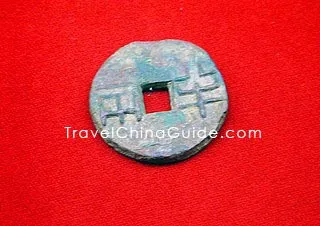
Accomplishments: There were huge amounts of successes, which brought great wealth and increased the economy of China, during the Qin Dynasty. Most of the accomplishments were recorded under the rule of Emperor Qin Shi. Qin Shi Huangdi introduced the philosophy of legalism for the first time in China. (http://en.wikipedia.org/wiki/Qin_Dynasty). “Legalism means the act of following all laws.” (http://en.wikipedia.org/wiki/Legalism_%28philosophy%29). Emperor Qin separated the entire area of Qin into 36 territories and each territory had a civil governor, a military commander and an imperial inspector. He also allowed private landowning. The Qin Dynasty created the Monetary System, which standardized the writing, language, and currency of China in order to communicate and trade throughout the country. Coins made of circular copper with a square hole in the middle. Measurements were also made stable and so was the length of the axle. The length of the axle had to be changed to prevent long, deep tracks. Emperor Qin concentrated on feeding his nation and so on farming was improved. (http://www.mnsu.edu/emuseum/prehistory/china/early_imperial_china/qin.html). He also set up a rule that stated that all men between the ages of 17 and 60 years old had to serve the army for at least one year. (http://en.wikipedia.org/wiki/Qin_Dynasty). Many architectural accomplishments were met. One huge example would be the, 4,856 kilometer long, Great Wall of China, which was started to prevent invaders from entering and also to unite the entire country. Emperor Qin also built an enormous, royal palace for himself. One positive thing he did for his nation was that he imposed laws and taxes for everyone. Another accomplishment came after the death of Emperor Qin Shi Huangdi. The people of Qin built an entire, 6,000 life-size men, army out of clay. These soldiers were known as the Terra Cotta army, which were designed to protect the Emperor’s tomb. (http://www.mnsu.edu/emuseum/prehistory/china/early_imperial_china/qin.html).

These are the copper coins used for trade.
(http://www.travelchinaguide.com/images/photogallery/volunteer/currency%201v000655tm.jpg)


This is the Great Wall of China.
(http://www.chinareview.com/images/attractions-great-wall.jpg)


This is the Terracotta Army, located in the Emperor Qin's tomb.
(http://www.wayfaring.info/images/Qin_Terra_Cotta_Warriors.jpg)


Reason for Fall: Emperor Qin Shi Huangdi proved to be the best emperor during the Qin Dynasty because the other two emperors lasted only four years. Although, Emperor Qin was good, he did a huge mistake by burning books, which angered the peasants. Emperor Qin died due to mercury poisoning and soon after the whole of China went into a rage. There were also a lot of deaths during building the Great Wall of China. There were rebellions against the second and third emperor and soon after the Han Dynasty took over. (http://library.thinkquest.org/12255/library/dynasty/qin.html).


Bibliography:

1. (http://en.wikipedia.org/wiki/Qin_Dynasty).

2.(http://www.mnsu.edu/emuseum/prehistory/china/early_imperial_china/qin.html).

3. (http://en.wikipedia.org/wiki/Zhou_Dynasty#Decline).

4. (http://en.wikipedia.org/wiki/Warring_States_Period).

5. (http://en.wikipedia.org/wiki/Legalism_%28philosophy%29).

6. (http://library.thinkquest.org/12255/library/dynasty/qin.html).

7. (http://en.wikipedia.org/wiki/Philip_V_of_Macedon).

Monday, December 3, 2007

Case Study: Iran Earthquake 2005

Where and When did it occur?

Iran, a country filled with 65 million people. A disastrous earthquake hit Iran in the year of 2005. The earthquake measured 6.4 on the Richter Scale, which is considered to be a devastating. The earthquake struck central Iran on Tuesday, February 22, 2005. The time of the earthquake was 5:55:22 AM (local time). The location of the epicenter was at 30.741°, 56.877°E and the focus was 14 km. below the surface. The epicenter was 55 km from the city of Kerman, 185 km from Sirjan, 270 km from Yazd, and 745 km from the capital city of Tehran.
(http://earthquake.usgs.gov/)

(Iran.Zarand.earthquake.jpg)

What happened?

This earthquake was caused by the movement of the Arabian Plate and the Eurasian Plate. The Arabian Plate is criss-crossed by two types of fault lines with the Eurasian Plate, constructive faults and conservative faults. . The Arabian Plate moves at a rate of 2 to 3 cm./year and once the pressure gets too high for the crust to stand it, it jerks and creates an earthquake.
(http://www.smh.com.au/)
(http://earthquake.usgs.gov)

(http://www.stvincent.ac.uk/Resources/EarthSci/Tectonics/images/conserv.gif)


Who were affected and why do people live in hazard prone areas?

The earthquake was one of the worst memories for people in Iran. The quake killed more than 400 people and injured over a thousand. In the city of Zarand, Kerman, 20 people were killed and 280 others wounded. A few people died, when the roof of the mosque fell down. Most of the people who died were living in the villages. People in Iran don’t really have a choice on where to live because no matter where they live, they are going to be living in a danger prone area. The tremors would be felt any where because the fault runs all the way across Iran and up to Turkmenistan. People can choose if they want to live closer or further from the fault line. Many villages are found near the fault line because the poor people cannot afford living in the city. Out from the city, these people can also hunt for animals and fish for food.
(http://edition.cnn.com/)

(http://english.people.com.cn/200502/23/images/0222_D03.jpg)


What were the effects and how are effects different between LEDCs and MEDCs?

The earthquake damaged huge amounts of property. The tremors from the earthquake caused mudslides which made it hard for rescuers to have access to villages. The quake affected 40 villages in all. Out of these 40 villages, seven were more than 90% damaged, while 25 were more than half damaged. The buildings that collapsed made it hard to dig out people or corpses. . Around 8,000 people had to be relocated to a new facility. There was heavy rain, which made it harder for injured survivors to survive any longer. Although the rain stopped, 3% of the survivors died due to infections. . The effects are a lot greater in LEDCs (Least Economically Developed Countries) than in MEDCs (Most Economically Developed Countries) due to the difference in technologies. Buildings, bridges, roads, etc. are much stronger in MEDCs than in LEDCs. The fact that medical technology is also readily available in MEDCs and will take shorter time for access, on the other hand, medication is a lot harder to reach in LEDCs. LEDCs also have an advantage because the total damage won’t be a lot compared to MEDCs. If a very strong earthquake strikes central Tokyo, damage will go to billions of dollars, as in LEDCs the repairments will cost less.
(http://edition.cnn.com/)
(http://www.smh.com.au/)

(http://cache.viewimages.com/xc/52236178.jpg)


What is being done about it and were there any volunteer programs to help?

The government has worked at their full potential to bring Iran back from the effects of the earthquake and it shows. Buildings are recovering fairly quickly and the government have replaced the homes of the poor people living in the villages. As soon as the earthquake devastated Southern Iran, local authorities were available for help. People were also helping by taking the wounded ones to the nearby hospital. There were motorcycles all over the place carrying injured ones by local citizens. Residents were digging through the rubble of the fallen walls to find dead bodies. Due to some in accessible places, the government had to send helicopters to rescue the trapped ones. They also sent crews to work on the electricity lines, since the power was down. The Iranian government did not appeal for international organizations for help. Relief flights also started from the capital city, Tehran. Later, the Australian government came for help and contributed through various movements. The Foreign Affairs and Trade contributed $350,000 and the AusAID provided food supplies and medical supplies. Funding was channelled through the International Federation of the Red Cross (IFRC) to the Iranian Red Crescent Society (IRCS). The World Health Organization (WHO) also contributed to help the victims. The IRCS distributed food baskets with hygiene kits to 7,000 families and provided shelters for over 12,000 people. Other organizations such as UNHRC and UNICEF also provided with sufficient help.
(http://reliefweb.int/)

(http://media.collegepublisher.com/media/paper851/stills/)


What are the possible prevention methods?

One way to prevent an enormous amount of damage resulting from a earthquake is to be prepared for one. One way to be prepared for a forthcoming earthquake is to check all the buildings that can’t withstand a earthquake with a magnitude of 7.0 or below. If there are such buildings, improve them and reinforce them to make them stronger. You can also prepare for yourself by having an earthquake kit by that can support you for three days. You can also situate all the heavy and big objects closer to the ground, so they don’t fall on someone. Scientists can now predict a certain area, in which there are possibilities of an earthquake. You can try to stay as far away from that danger zone as possible. Scientists also have an bare idea of when an earthquake can occur due to past patterns of earthquakes and the average movements of plates.
(http://en.wikipedia.org/)

Thursday, November 29, 2007

Here, you can learn more about the earthquake that devastated life in Mid-Western Asia.